Search results for tag "Psychology" - 6 answer(s)
We live in our ego… well, I don’t know about you, but that is certainly true for myself. This became clear to me after I listened to—and reflected on—the distinction between surface conscious self and deep conscious self as it is presented here. The surface conscious self is my ego, my demanding self, this self that wants to be recognised by others, that wants others to love me, admire me, that wants everything to be for me and only for me, that takes every opportunity to get offended, that gets on its high horse over the tiniest criticism, that sees itself at the centre of the world with everybody else on the outskirts, that thinks I know better, that dreads getting relegated to second place and doesn’t like its rivals to succeed at anything, that revels in compliments and remembers them with delight, that believed others owe me attention, consideration, that they should listen to me…
Lire la suite
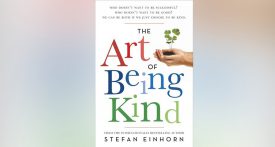
The art of being kind—or how to demonstrate that kindness, contrary to what society often claims, is not a weakness but an ethical quality. This is no easy task but Stefan Einhorn, an oncologist at Karolinska Hospital in Stockholm, makes a very convincing point in his book The Art of Being Kind.
Stefan Einhorn begins by observing that kindness has a relatively bad reputation, and is often likened to weakness, simple-mindedness or just plain stupidity. Einhorn, however, defines kindness as a form of intelligence: “kindness as I understand it […] is not the fruit of stupidity but rather of common sense”. It is a quality that enables us to live according to an ethics of the heart by taking the well being of others into consideration. Kindness redefined then as “the art of being human among humans”, gives it new depth.
Lire la suite
The id or the terrestrial soul is the part of us that constitutes the source of our material instincts. When these instincts lead us to harm other people or the celestial part of our selves, the id takes on the face of the imperious self, an unethical and anti-divine instinct-driven faculty that stands in opposition to our perfection.
In Freud’s structural model, the id is the name given to the instinctual entity from which all of our instincts spring, alongside the super-ego—the seat of morality—and the ego—the centre of willpower and conscious reasoning.
Lire la suite
Many years ago, I was reading a chapter in Bahram Elahi‘s The Foundations of Natural Spirituality when a paragraph leaped out and grabbed my attention.
“God is in everything, everywhere and with everyone. Whether in a dream or while we are awake, directly or indirectly, through the intermediary of His messengers or those who are loved by us, or through any other means—even a passerby in the street—He communicates with each one of us. But in order to hear Him and to understand Him, we must first learn how to decode His messages.”
Lire la suite
What is it in me that says “I”? What is the nature of that consciousness of my self? What is my spirit made of? How am I psychologically constructed? We can ask this question in so many different ways, replace one term by another, we will always return to the same enigma: what is it in me that produces the feeling of existing, but also rules my behaviour, my thoughts and my emotions? What is this thing, which we could call the self, that enables me to think, to decide, to feel; that keeps all my experiences and gives me the innermost feeling of being myself, of having my own identity?
This lecture explores The model of the self according to Bahram Elahi as compared to the models put forward by neurosciences or Freud’s psychoanalytic model.
Lire la suite
Virtue ethics can be defined as an ethical approach that emphasises the character of the agent. Whereas consequentialism emphasises the consequences of the action, and deontological ethics the rules that one may follow, virtue ethics define a virtuous act by a certain virtue in the agent, for example benevolence or generosity. Virtue ethics is not in conflict with deontological or consequentialist approaches, and can even be reconciled with them. The action driven by virtue ethics actually precedes the other two approaches: while deontological ethics or consequentialism addresses what is to be done in any given situation, virtue ethics focuses on the ways to develop certain virtues, or character patterns, in order to act well when needed. The main problem for virtue ethics, then, is 1) to define which virtues are desirable, and 2) how to develop them.
Lire la suite
|

 News
News Podcast





Recent Comments