1565
Vote
Ostad Elahi used to define his teachings as a new medicine of the soul: one that is adapted to the true nature of human beings and adheres to the law of causality governing both their spiritual and material lives. The spirituality he practiced was natural spirituality, and he considered the process of spiritual perfection to resemble an academic curriculum.
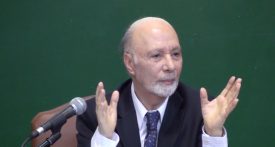
The excerpts presented here are drawn from a lecture given at the Sorbonne in March 2011, in which Professor Bahram Elahi revisits various aspects of Ostad Elahi’s philosophy. Rephrasing them in a simple and direct manner, he relates these points to fundamental questions and examines them from a rational standpoint.
Read more
649
Vote
If our approach to spirituality is to be rational, where should we stand on the issue of worlds and the interworld? Must we blindly “believe” what we are told and view such concepts as mere revelation, or should we consider the possibility of their existence in a rational way?
One way of attempting a “rational” apprehension of worlds and the Interworld is to reflect on the notion of “absolute divine justice”. Let’s lay out the following alternative: either there is such a thing as divine justice (God is just), or it is mere fancy.
Read more
863
Vote
Pascal was right: proofs of the existence of God are of no avail when it comes to giving faith to the faithless. To realize that a divine scheme is at work in the universe requires more than rational arguments. What, then, is needed? In Knowing the Spirit (p. 45), Ostad Elahi provides the reader with a clue. He speaks of the voice of conscience as an inner device capable of attesting to the existence of God. Now, what does voice of conscience mean? Where does it come from and how exactly can it lead us to acknowledge the existence of God?
Read more
476
Vote
In elaborating proofs for God’s existence, oriental and occidental philosophers alike did not necessarily intend to instil faith in those who were lacking it. When he wrote chapter 1 of Knowing the Spirit, which deals exclusively with this very question, Ostad Elahi was well aware that none of the arguments he presented could actually prove […]
Read more
371
Vote
In attempting to reconcile faith and reason, philosophers have produced what is traditionally called “proofs of the existence of God”. These proofs usually present themselves as sophisticated arguments. As such, they are open to disputation and, one must admit, hardly convincing. It is by reference to them that Pascal wrote: “The metaphysical proofs of God are so remote from the reasoning of men, and so complicated, that they make little impression; and if they should be of service to some, it would be only during the moment that they see such demonstration; but an hour afterwards they fear they have been mistaken.” (Pensées, 543)
Read more

 News
News Podcast






Recent Comments