
 News
News Podcast

A lesson by Victor Hugo


After nineteen years in the galleys, Jean Valjean has begun anew—he has acquired a new identity. Monsieur Madeleine is now a respected dignitary. As an industrialist and the mayor of Montreuil-sur-Mer, he dedicates himself to the good of the community and is highly regarded for his generosity, courage and philanthropy. One day, however, his past catches up with him when police inspector Javert arrives to announce the arrest and imminent trial of a certain Champmathieu, a simpleton who is accused of having stolen some apples and who is mistakenly identified as Jean Valjean, the ex-convict. For Jean Valjean’s innocent lookalike the consequences are dire because the theft is requalified as a repeat offense. The misdemeanor is then treated as a crime and is no longer an affair for the misdemeanor division, but becomes an affair for a Criminal Court. Will Madeleine-Valjean allow a poor innocent man to pay for crimes he has not committed? It would be quite easy: he could simply let things run their course. Or will he on the contrary reveal his true identity to clear the man, exposing himself to a reexamination of his entire past and submit himself to trial?
In this excerpt from Les Misérables, Victor Hugo masterfully delivers an example of an inner dialogue between the terrestrial part and the celestial part of the human psyche. Here, the reader witnesses the expression of multiple voices within the conscious self of the character—the judgement of reason and the appeals of the conscience confronted with the treacherous suggestions of the imperious self.
Our daily dilemmas no doubt manifest less loudly than those of Jean Valjean in this “Storm in a Skull”. Nevertheless, the times in which we must choose between good and evil, right and wrong, are much more frequent than we may think, and it is these same voices that we hear in our minds. Voices that care only for our comfort and our reputation in this world and voices that remind us that this world is merely a means to another end. Much like Jean Valjean, if we wish our choices to bring us closer to our true goal, we must begin by hearing and identifying the faculties that speak within us.

Edmond Yon, circa 1865, Une tempête sous un crâne, wikimedia
He examined the situation, and found it unprecedented; so unprecedented that in the midst of his revery he rose from his chair, moved by some inexplicable impulse of anxiety, and bolted his door. He feared lest something more should enter. He was barricading himself against possibilities.
A moment later he extinguished his light; it embarrassed him.
It seemed to him as though he might be seen.
By whom?
Alas! That on which he desired to close the door had already entered; that which he desired to blind was staring him in the face,– his conscience.
His conscience; that is to say, God.
Nevertheless, he deluded himself at first; he had a feeling of security and of solitude; the bolt once drawn, he thought himself impregnable; the candle extinguished, he felt himself invisible. Then he took possession of himself: he set his elbows on the table, leaned his head on his hand, and began to meditate in the dark.
“Where do I stand? Am not I dreaming? What have I heard? Is it really true that I have seen that Javert, and that he spoke to me in that manner? Who can that Champmathieu be? So he resembles me! Is it possible? When I reflect that yesterday I was so tranquil, and so far from suspecting anything! What was I doing yesterday at this hour? What is there in this incident? What will the end be? What is to be done?”
This was the torment in which he found himself. His brain had lost its power of retaining ideas; they passed like waves, and he clutched his brow in both hands to arrest them.
Nothing but anguish extricated itself from this tumult which overwhelmed his will and his reason, and from which he sought to draw proof and resolution.
His head was burning. He went to the window and threw it wide open. There were no stars in the sky. He returned and seated himself at the table.
The first hour passed in this manner.
Gradually, however, vague outlines began to take form and to fix themselves in his meditation, and he was able to catch a glimpse with precision of the reality,–not the whole situation, but some of the details. He began by recognizing the fact that, critical and extraordinary as was this situation, he was completely master of it.
This only caused an increase of his stupor.
Independently of the severe and religious aim which he had assigned to his actions, all that he had made up to that day had been nothing but a hole in which to bury his name. That which he had always feared most of all in his hours of self-communion, during his sleepless nights, was to ever hear that name pronounced; he had said to himself, that that would be the end of all things for him; that on the day when that name made its reappearance it would cause his new life to vanish from about him, and–who knows?– perhaps even his new soul within him, also. He shuddered at the very thought that this was possible. Assuredly, if anyone had said to him at such moments that the hour would come when that name would ring in his ears, when the hideous words, Jean Valjean, would suddenly emerge from the darkness and rise in front of him, when that formidable light, capable of dissipating the mystery in which he had enveloped himself, would suddenly blaze forth above his head, and that that name would not menace him, that that light would but produce an obscurity more dense, that this rent veil would but increase the mystery, that this earthquake would solidify his edifice, that this prodigious incident would have no other result, so far as he was concerned, if so it seemed good to him, than that of rendering his existence at once clearer and more impenetrable, and that, out of his confrontation with the phantom of Jean Valjean, the good and worthy citizen Monsieur Madeleine would emerge more honored, more peaceful, and more respected than ever–if anyone had told him that, he would have tossed his head and regarded the words as those of a madman. Well, all this was precisely what had just come to pass; all that accumulation of impossibilities was a fact, and God had permitted these wild fancies to become real things!
His revery continued to grow clearer. He came more and more to an understanding of his position.
It seemed to him that he had but just waked up from some inexplicable dream, and that he found himself slipping down a declivity in the middle of the night, erect, shivering, holding back all in vain, on the very brink of the abyss. He distinctly perceived in the darkness a stranger, a man unknown to him, whom destiny had mistaken for him, and whom she was thrusting into the gulf in his stead; in order that the gulf might close once more, it was necessary that someone, himself or that other man, should fall into it: he had only let things take their course.
[…]
He hastily relighted his candle.
“Well, what then?” he said to himself; “what am I afraid of? What is there in all that for me to think about? I am safe; all is over. I had but one partly open door through which my past might invade my life, and behold that door is walled up forever! That Javert, who has been annoying me so long; that terrible instinct which seemed to have divined me, which had divined me– good God! and which followed me everywhere; that frightful hunting-dog, always making a point at me, is thrown off the scent, engaged elsewhere, absolutely turned from the trail: henceforth he is satisfied; he will leave me in peace; he has his Jean Valjean. Who knows? it is even probable that he will wish to leave town! And all this has been brought about without any aid from me, and I count for nothing in it! Ah! but where is the misfortune in this? Upon my honor, people would think, to see me, that some catastrophe had happened to me! After all, if it does bring harm to someone, that is not my fault in the least: it is Providence which has done it all; it is because it wishes it so to be, evidently. Have I the right to disarrange what it has arranged? What do I ask now? Why should I meddle? It does not concern me; what! I am not satisfied: but what more do I want? The goal to which I have aspired for so many years, the dream of my nights, the object of my prayers to Heaven,–security,–I have now attained; it is God who wills it; I can do nothing against the will of God, and why does God will it? In order that I may continue what I have begun, that I may do good, that I may one day be a grand and encouraging example, that it may be said at last, that a little happiness has been attached to the penance which I have undergone, and to that virtue to which I have returned. Really, I do not understand why I was afraid, a little while ago, to enter the house of that good cure, and to ask his advice; this is evidently what he would have said to me: It is settled; let things take their course; let the good God do as he likes!”
Thus did he address himself in the depths of his own conscience, bending over what may be called his own abyss; he rose from his chair, and began to pace the room: “Come,” said he, “let us think no more about it; my resolve is taken!” but he felt no joy.
Quite the reverse.
One can no more prevent thought from recurring to an idea than one can the sea from returning to the shore: the sailor calls it the tide; the guilty man calls it remorse; God upheaves the soul as he does the ocean.
After the expiration of a few moments, do what he would, he resumed the gloomy dialogue in which it was he who spoke and he who listened, saying that which he would have preferred to ignore, and listened to that which he would have preferred not to hear, yielding to that mysterious power which said to him: “Think!” as it said to another condemned man, two thousand years ago, “March on!”
Before proceeding further, and in order to make ourselves fully understood, let us insist upon one necessary observation.
It is certain that people do talk to themselves; there is no living being who has not done it. It may even be said that the word is never a more magnificent mystery than when it goes from thought to conscience within a man, and when it returns from conscience to thought; it is in this sense only that the words so often employed in this chapter, he said, he exclaimed, must be understood; one speaks to one’s self, talks to one’s self, exclaims to one’s self without breaking the external silence; there is a great tumult; everything about us talks except the mouth. The realities of the soul are none the less realities because they are not visible and palpable.
So he asked himself where he stood. He interrogated himself upon that “settled resolve.” He confessed to himself that all that he had just arranged in his mind was monstrous, that “to let things take their course, to let the good God do as he liked,” was simply horrible; to allow this error of fate and of men to be carried out, not to hinder it, to lend himself to it through his silence, to do nothing, in short, was to do everything! that this was hypocritical baseness in the last degree! that it was a base, cowardly, sneaking, abject, hideous crime!
For the first time in eight years, the wretched man had just tasted the bitter savor of an evil thought and of an evil action.
He spit it out with disgust.
He continued to question himself. He asked himself severely what he had meant by this, “My object is attained!” He declared to himself that his life really had an object; but what object? To conceal his name? To deceive the police? Was it for so petty a thing that he had done all that he had done? Had he not another and a grand object, which was the true one–to save, not his person, but his soul; to become honest and good once more; to be a just man? Was it not that above all, that alone, which he had always desired, which the Bishop had enjoined upon him–to shut the door on his past? But he was not shutting it! great God! he was re-opening it by committing an infamous action! He was becoming a thief once more, and the most odious of thieves! He was robbing another of his existence, his life, his peace, his place in the sunshine. He was becoming an assassin. He was murdering, morally murdering, a wretched man. He was inflicting on him that frightful living death, that death beneath the open sky, which is called the galleys. On the other hand, to surrender himself to save that man, struck down with so melancholy an error, to resume his own name, to become once more, out of duty, the convict Jean Valjean, that was, in truth, to achieve his resurrection, and to close forever that hell whence he had just emerged; to fall back there in appearance was to escape from it in reality. This must be done! He had done nothing if he did not do all this; his whole life was useless; all his penitence was wasted. There was no longer any need of saying, “What is the use?” He felt that the Bishop was there, that the Bishop was present all the more because he was dead, that the Bishop was gazing fixedly at him, that henceforth Mayor Madeleine, with all his virtues, would be abominable to him, and that the convict Jean Valjean would be pure and admirable in his sight; that men beheld his mask, but that the Bishop saw his face; that men saw his life, but that the Bishop beheld his conscience. So he must go to Arras, deliver the false Jean Valjean, and denounce the real one. Alas! that was the greatest of sacrifices, the most poignant of victories, the last step to take; but it must be done. Sad fate! he would enter into sanctity only in the eyes of God when he returned to infamy in the eyes of men.
“Well,” said he, “let us decide upon this; let us do our duty; let us save this man.” He uttered these words aloud, without perceiving that he was speaking aloud.
[…]
But the fever, allayed for an instant, gradually resumed possession of him. A thousand thoughts traversed his mind, but they continued to fortify him in his resolution.
One moment he said to himself that he was, perhaps, taking the matter too keenly; that, after all, this Champmathieu was not interesting, and that he had actually been guilty of theft.
He answered himself: “If this man has, indeed, stolen a few apples, that means a month in prison. It is a long way from that to the galleys. And who knows? Did he steal? Has it been proved? The name of Jean Valjean overwhelms him, and seems to dispense with proofs. Do not the attorneys for the Crown always proceed in this manner? He is supposed to be a thief because he is known to be a convict.”
In another instant the thought had occurred to him that, when he denounced himself, the heroism of his deed might, perhaps, be taken into consideration, and his honest life for the last seven years, and what he had done for the district, and that they would have mercy on him.
But this supposition vanished very quickly, and he smiled bitterly as he remembered that the theft of the forty sous from little Gervais put him in the position of a man guilty of a second offence after conviction, that this affair would certainly come up, and, according to the precise terms of the law, would render him liable to penal servitude for life.
He turned aside from all illusions, detached himself more and more from earth, and sought strength and consolation elsewhere. He told himself that he must do his duty; that perhaps he should not be more unhappy after doing his duty than after having avoided it; that if he allowed things to take their own course, if he remained at Montreuil sur Mer, his consideration, his good name, his good works, the deference and veneration paid to him, his charity, his wealth, his popularity, his virtue, would be seasoned with a crime. And what would be the taste of all these holy things when bound up with this hideous thing? while, if he accomplished his sacrifice, a celestial idea would be mingled with the galleys, the post, the iron necklet, the green cap, unceasing toil, and pitiless shame.
At length he told himself that it must be so, that his destiny was thus allotted, that he had not authority to alter the arrangements made on high, that, in any case, he must make his choice: virtue without and abomination within, or holiness within and infamy without.
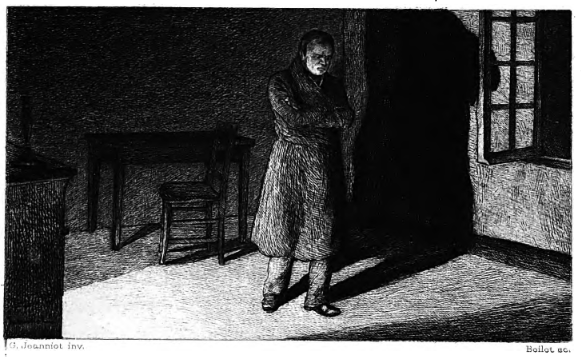
Pierre-Georges Jeanniot, Illustration of Les Misérables, 1890. Volume I, book vii, chapter 3, wikimedia
[…]
He was cold; he lighted a small fire; it did not occur to him to close the window.
In the meantime he had relapsed into his stupor; he was obliged to make a tolerably vigorous effort to recall what had been the subject of his thoughts before midnight had struck; he finally succeeded in doing this.
“Ah! yes,” he said to himself, “I had resolved to inform against myself.”
And then, all of a sudden, he thought of Fantine.
“Hold!” said he, “and what about that poor woman?”
Here a fresh crisis declared itself.
Fantine, by appearing thus abruptly in his revery, produced the effect of an unexpected ray of light; it seemed to him as though everything about him were undergoing a change of aspect: he exclaimed:–
“Ah! but I have hitherto considered no one but myself; it is proper for me to hold my tongue or to denounce myself, to conceal my person or to save my soul, to be a despicable and respected magistrate, or an infamous and venerable convict; it is I, it is always I and nothing but I: but, good God! all this is egotism; these are diverse forms of egotism, but it is egotism all the same. What if I were to think a little about others? The highest holiness is to think of others; come, let us examine the matter. The _I_ excepted, the _I_ effaced, the _I_ forgotten, what would be the result of all this? What if I denounce myself? I am arrested; this Champmathieu is released; I am put back in the galleys; that is well– and what then? What is going on here? Ah! here is a country, a town, here are factories, an industry, workers, both men and women, aged grandsires, children, poor people! All this I have created; all these I provide with their living; everywhere where there is a smoking chimney, it is I who have placed the brand on the hearth and meat in the pot; I have created ease, circulation, credit; before me there was nothing; I have elevated, vivified, informed with life, fecundated, stimulated, enriched the whole country-side; lacking me, the soul is lacking; I take myself off, everything dies: and this woman, who has suffered so much, who possesses so many merits in spite of her fall; the cause of all whose misery I have unwittingly been! And that child whom I meant to go in search of, whom I have promised to her mother; do I not also owe something to this woman, in reparation for the evil which I have done her? If I disappear, what happens? The mother dies; the child becomes what it can; that is what will take place, if I denounce myself. If I do not denounce myself? Come, let us see how it will be if I do not denounce myself.”
After putting this question to himself, he paused; he seemed to undergo a momentary hesitation and trepidation; but it did not last long, and he answered himself calmly:–
“Well, this man is going to the galleys; it is true, but what the deuce! he has stolen! There is no use in my saying that he has not been guilty of theft, for he has! I remain here; I go on: in ten years I shall have made ten millions; I scatter them over the country; I have nothing of my own; what is that to me? It is not for myself that I am doing it; the prosperity of all goes on augmenting; industries are aroused and animated; factories and shops are multiplied; families, a hundred families, a thousand families, are happy; the district becomes populated; villages spring up where there were only farms before; farms rise where there was nothing; wretchedness disappears, and with wretchedness debauchery, prostitution, theft, murder; all vices disappear, all crimes: and this poor mother rears her child; and behold a whole country rich and honest! Ah! I was a fool! I was absurd! what was that I was saying about denouncing myself? I really must pay attention and not be precipitate about anything. What! because it would have pleased me to play the grand and generous; this is melodrama, after all; because I should have thought of no one but myself, the idea! for the sake of saving from a punishment, a trifle exaggerated, perhaps, but just at bottom, no one knows whom, a thief, a good-for-nothing, evidently, a whole country-side must perish! a poor woman must die in the hospital! a poor little girl must die in the street! like dogs; ah, this is abominable! And without the mother even having seen her child once more, almost without the child’s having known her mother; and all that for the sake of an old wretch of an apple-thief who, most assuredly, has deserved the galleys for something else, if not for that; fine scruples, indeed, which save a guilty man and sacrifice the innocent, which save an old vagabond who has only a few years to live at most, and who will not be more unhappy in the galleys than in his hovel, and which sacrifice a whole population, mothers, wives, children. This poor little Cosette who has no one in the world but me, and who is, no doubt, blue with cold at this moment in the den of those Thenardiers; those peoples are rascals; and I was going to neglect my duty towards all these poor creatures; and I was going off to denounce myself; and I was about to commit that unspeakable folly! Let us put it at the worst: suppose that there is a wrong action on my part in this, and that my conscience will reproach me for it some day, to accept, for the good of others, these reproaches which weigh only on myself; this evil action which compromises my soul alone; in that lies self-sacrifice; in that alone there is virtue.”
He rose and resumed his march; this time, he seemed to be content.
Diamonds are found only in the dark places of the earth; truths are found only in the depths of thought. It seemed to him, that, after having descended into these depths, after having long groped among the darkest of these shadows, he had at last found one of these diamonds, one of these truths, and that he now held it in his hand, and he was dazzled as he gazed upon it.
“Yes,” he thought, “this is right; I am on the right road; I have the solution; I must end by holding fast to something; my resolve is taken; let things take their course; let us no longer vacillate; let us no longer hang back; this is for the interest of all, not for my own; I am Madeleine, and Madeleine I remain. Woe to the man who is Jean Valjean! I am no longer he; I do not know that man; I no longer know anything; it turns out that someone is Jean Valjean at the present moment; let him look out for himself; that does not concern me; it is a fatal name which was floating abroad in the night; if it halts and descends on a head, so much the worse for that head.”
He looked into the little mirror which hung above his chimney-piece, and said:–
“Hold! it has relieved me to come to a decision; I am quite another man now.”
He proceeded a few paces further, then he stopped short.
“Come!” he said, “I must not flinch before any of the consequences of the resolution which I have once adopted; there are still threads which attach me to that Jean Valjean; they must be broken; in this very room there are objects which would betray me, dumb things which would bear witness against me; it is settled; all these things must disappear.”
He fumbled in his pocket, drew out his purse, opened it, and took out a small key; he inserted the key in a lock whose aperture could hardly be seen, so hidden was it in the most somber tones of the design which covered the wall-paper; a secret receptacle opened, a sort of false cupboard constructed in the angle between the wall and the chimney-piece; in this hiding-place there were some rags– a blue linen blouse, an old pair of trousers, an old knapsack, and a huge thorn cudgel shod with iron at both ends. Those who had seen Jean Valjean at the epoch when he passed through Digne in October, 1815, could easily have recognized all the pieces of this miserable outfit.
He had preserved them as he had preserved the silver candlesticks, in order to remind himself continually of his starting-point, but he had concealed all that came from the galleys, and he had allowed the candlesticks which came from the Bishop to be seen.
He cast a furtive glance towards the door, as though he feared that it would open in spite of the bolt which fastened it; then, with a quick and abrupt movement, he took the whole in his arms at once, without bestowing so much as a glance on the things which he had so religiously and so perilously preserved for so many years, and flung them all, rags, cudgel, knapsack, into the fire.
[…]
At that moment it seemed to him that he heard a voice within him shouting: “Jean Valjean! Jean Valjean!”
His hair rose upright: he became like a man who is listening to some terrible thing.
“Yes, that’s it! finish!” said the voice. “Complete what you are about! Destroy these candlesticks! Annihilate this souvenir! Forget the Bishop! Forget everything! Destroy this Champmathieu, do! That is right! Applaud yourself! So it is settled, resolved, fixed, agreed: here is an old man who does not know what is wanted of him, who has, perhaps, done nothing, an innocent man, whose whole misfortune lies in your name, upon whom your name weighs like a crime, who is about to be taken for you, who will be condemned, who will finish his days in abjectness and horror. That is good! Be an honest man yourself; remain Monsieur le Maire; remain honorable and honored; enrich the town; nourish the indigent; rear the orphan; live happy, virtuous, and admired; and, during this time, while you are here in the midst of joy and light, there will be a man who will wear your red blouse, who will bear your name in ignominy, and who will drag your chain in the galleys. Yes, it is well arranged thus. Ah, wretch!”
The perspiration streamed from his brow. He fixed a haggard eye on the candlesticks. But that within him which had spoken had not finished. The voice continued:–
“Jean Valjean, there will be around you many voices, which will make a great noise, which will talk very loud, and which will bless you, and only one which no one will hear, and which will curse you in the dark. Well! listen, infamous man! All those benedictions will fall back before they reach heaven, and only the malediction will ascend to God.”
This voice, feeble at first, and which had proceeded from the most obscure depths of his conscience, had gradually become startling and formidable, and he now heard it in his very ear. It seemed to him that it had detached itself from him, and that it was now speaking outside of him. He thought that he heard the last words so distinctly, that he glanced around the room in a sort of terror.
“Is there anyone here?” he demanded aloud, in utter bewilderment.
Then he resumed, with a laugh which resembled that of an idiot:–
“How stupid I am! There can be no one!”
There was someone; but the person who was there was of those whom the human eye cannot see.
He placed the candlesticks on the chimney-piece.
Then he resumed his monotonous and lugubrious tramp, which troubled the dreams of the sleeping man beneath him, and awoke him with a start.
This tramping to and fro soothed and at the same time intoxicated him. It sometimes seems, on supreme occasions, as though people moved about for the purpose of asking advice of everything that they may encounter by change of place. After the lapse of a few minutes he no longer knew his position.
He now recoiled in equal terror before both the resolutions at which he had arrived in turn. The two ideas which counselled him appeared to him equally fatal. What a fatality! What conjunction that that Champmathieu should have been taken for him; to be overwhelmed by precisely the means which Providence seemed to have employed, at first, to strengthen his position!
There was a moment when he reflected on the future. Denounce himself, great God! Deliver himself up! With immense despair he faced all that he should be obliged to leave, all that he should be obliged to take up once more. He should have to bid farewell to that existence which was so good, so pure, so radiant, to the respect of all, to honor, to liberty. He should never more stroll in the fields; he should never more hear the birds sing in the month of May; he should never more bestow alms on the little children; he should never more experience the sweetness of having glances of gratitude and love fixed upon him; he should quit that house which he had built, that little chamber! Everything seemed charming to him at that moment. Never again should he read those books; never more should he write on that little table of white wood; his old portress, the only servant whom he kept, would never more bring him his coffee in the morning. Great God! instead of that, the convict gang, the iron necklet, the red waistcoat, the chain on his ankle, fatigue, the cell, the camp bed all those horrors which he knew so well! At his age, after having been what he was! If he were only young again! but to be addressed in his old age as “thou” by anyone who pleased; to be searched by the convict-guard; to receive the galley-sergeant’s cudgellings; to wear iron-bound shoes on his bare feet; to have to stretch out his leg night and morning to the hammer of the roundsman who visits the gang; to submit to the curiosity of strangers, who would be told: “That man yonder is the famous Jean Valjean, who was mayor of M. sur M.”; and at night, dripping with perspiration, overwhelmed with lassitude, their green caps drawn over their eyes, to remount, two by two, the ladder staircase of the galleys beneath the sergeant’s whip. Oh, what misery! Can destiny, then, be as malicious as an intelligent being, and become as monstrous as the human heart?
And do what he would, he always fell back upon the heartrending dilemma which lay at the foundation of his revery: “Should he remain in paradise and become a demon? Should he return to hell and become an angel?”
What was to be done? Great God! what was to be done?
Victor Hugo, Les Misérables, 1862, Volume 1, Book 7, Chapter III, translated by Isabel F. Hapgood, available online here.
Let’s reactivate our classics!
Inner dialogues like this occur on a daily basis. When did you last realize you were having one? Was it easy for you to identify the faculties that were expressing themselves in you?
You are welcome to share your thoughts and experiences in the comment section.
Photo credit: author: Joliot. Cover of Les Misérables as published by Jules Rouff et Cie , circa 1879. Source: Paris Musées. Available online here.
 This work is offered under a Creative
Commons licence
This work is offered under a Creative
Commons licence


I have these types of dialogues in my head all the time. Most of the time, I can manage to figure out which voice is the imperious self and which one is the inner guide. But when I read this story, it really scared me because I’m afraid the imperious self might deceive me, and it is certainly very skillful at doing so. I think the only way out is to sincerely ask God to help us, show us the right way, and protect us from the evil within us.
Such a moving story!
The situation feels so much harder because it involves the rights of another person.
When I am caught in a similar dilemma, I ask The One for his guidance, and I know that if my intention is pure, I will receive some sort of a signal which leads me to the right decision.
I rely on His “karam” to show me the way.
What a beautiful and practical article. Interestingly enough, I have started slowly reading this book since last year, and although in the beginning I found it a bit slow and hard to read, later I felt in love with it, and I could notice many practical implications. I am still far behind the chapter “Storm in Skull” but I took the pleasure and liberty to read it here.
1.
“Assuredly, if anyone had said to him at such moments that the hour would come when…that this earthquake would solidify his edifice, that this prodigious incident would have no other result, so far as he was concerned, if so it seemed good to him, than that of rendering his existence at once clearer and more impenetrable, and that, out of his confrontation with the phantom of Jean Valjean, the good and worthy citizen Monsieur Madeleine would emerge more honored, more peaceful, and more respected than ever–if anyone had told him that, he would have tossed his head and regarded the words as those of a madman. Well, all this was precisely what had just come to pass; all that accumulation of impossibilities was a fact, and God had permitted these wild fancies to become real things!”
I have been reflecting on the above for the past few days, finding it very reassuring and motivating, to remind myself of it, when facing challenges of everyday (including but not limited to anxiety, fear, despair, anger, frustration, material challenges, etc.) when the imperious self highjacks and takes control of my whole soul.
2.
Reviewing my past few days, I noticed despite being aware of similar inner dialogue in my daily life, I barely recognized and categorized such thoughts as an “inner dialogue” but instead as a single stream of thought that defines me, as “me”. In other words, I barely label if a thought is from my ego/imperious self or inner guide. By reflecting back, I could clearly see the dialogues and label imperious self and inner guide accordingly (and not surprisingly mostly imperious self is at work).
I noticed that anytime that I just simply labeled my thought as either “ego” or “inner guide,” I had much more success fighting it (and if necessary, taking the right action), as opposed to when I just subconsciously noticed that certain thought was negative and attempted to force it out of my mind without the use of labeling. This somehow corresponds to the following study:
“In one brain imaging study [“Putting Feelings into Words: Affect Labeling Disrupts Amygdala Activity in Response to Affective Stimuli,” Psychological Science 18, no. 5 (May 2007): 421–28.] psychology professor Matthew Lieberman of the University of California, Los Angeles, found that when people are shown photos of faces expressing strong emotion, the brain shows greater activity in the amygdala, the part that generates fear. But when they are asked to label the emotion, the activity moves to the areas that govern rational thinking. In other words, labeling an emotion—applying rational words to a fear—disrupts its raw intensity.” — Never Split the Difference: Negotiating As If Your Life Depended On It by Chris Voss, Tahl Raz
3.
I found it very effective to look at every spiritual test, as if it’s my last test, here on Earth:
“This must be done! He had done nothing if he did not do all this; his whole life was useless”.
This somehow reminds me of the chapter 19 of the Practical Guide:
“From a spiritual standpoint, as long as we are here on this earth, we have but one essential duty: to complete the fundamental stage in our process of spiritual perfection.” – Fundamentals of the Process of Spiritual Perfection: A Practical Guide by Bahram Elahi MD
The ethical conclusion in this excerpt from Les Misérables revolves around the conflict between self-interest and moral responsibility. Jean Valjean faces a profound moral dilemma: should he sacrifice himself to save an innocent man falsely accused of being him, or remain silent to preserve the life of virtue and service he has built for himself and others?
Ultimately, the ethical crux of the passage is the realization that true virtue involves self-sacrifice and thinking beyond oneself. Valjean struggles with his conscience, which reminds him that maintaining his comfortable life at the expense of another’s suffering would be an act of selfishness and moral failure. The passage underscores the theme that integrity requires prioritizing the greater good and justice, even at great personal cost.
This highlights Hugo’s broader commentary on the nature of morality, the impact of individual actions on society, and the transformative power of selflessness.
An example of a daily inner dialogue could be deciding whether to speak up in a difficult situation:
Imagine you witness a colleague being unfairly criticized by your manager. Internally, you might think:
“Should I intervene and defend them? It’s the right thing to do, but it could make me look bad or put my position at risk.”
“But if I stay silent, am I complicit in their mistreatment? I would feel guilty knowing I didn’t stand up for someone who needed help.”
This inner conflict highlights the tension between courage and self-preservation. Reflecting on the faculties at play, you might recognize empathy urging you to act and fear pulling you back. It’s a moment of grappling with values versus comfort, much like Valjean’s struggle in Les Misérables.
>>Imagine you witness a colleague being unfairly criticized by your manager. Internally, you might think: “Should I intervene and defend them? It’s the right thing to do, but it could make me look bad or put my position at risk.” “But if I stay silent, am I complicit in their mistreatment? I would feel guilty knowing I didn’t stand up for someone who needed help.”
thank you for mentioning the above possible scenario. Recently I was confronted with a similar, albeit less challenging scenario: a work colleague repeatedly criticized another colleague behind his back and it was only partially justified. It took me several weeks to actually defend and speak well of the victim. So I wonder how long it would have taken me to react if I had been confronted by a manager’s backbiting instead of just a colleague’s. I need to react more swiftly in the future.
@Yan, you beautifully emphasized Part 3—the urgency and importance of viewing life’s challenges as opportunities for spiritual growth. The connection between seeing each test as potentially final and focusing on fulfilling one’s spiritual duty is profound. It reminds us to approach life with intention and commitment, ensuring that no effort is wasted on our journey toward self-improvement and spiritual perfection.
My job requires me to travel almost constantly, and I come home exhausted. The fatigue is accentuated by the fact that not only are my trips long (several hours) since I travel between two countries, but also because the planes often accumulate delays, especially at the end of the day. However, we happen to have a friend who is very careful with his money and frequently asks us for hospitality. As a result, I often have to take care of him despite my fatigue. Here is an excerpt from my internal dialogues.
ARGUMENT 1 — You are exhausted, and he starts endless monologues without realizing the situation
Answer 1 — If you want to develop your generosity, you must try and fight against your selfishness. Maybe you are at level 1 or 2, and to move to the next level, you must work. Consider your friend S. and see how generous he is with his time despite the nights on call at the hospital and the fact that he is dead tired in the evening after a sleepless night. He is always available to others. In addition, you can give him a reasonable and honorable amount of time without this time being excessive: for example, 30 minutes in the evening (if it is late) and/or 1:30 hours during lunch/dinner.
ARGUMENT 2 – He never brings anything, he is stingy, he has come dozens of times and he must have saved thousands of euros. By his own admission he has quite a bit of money set aside and he could contribute to the expenses; he arrives and expects to be fed. He has money problems with his brother, with his ex-wife, with his father’s wife… he doesn’t get along with anyone in his family because he is stingy. He only spends money on his son.
Answer 2 A – He has invited you several times with your wife, and each time you have refused. In addition, he has been unemployed for 12 months.
Answer 2 B — Each time he stays with us, if I make it clear to him that having dinner/lunch together will be complicated (because we have to take care of our son, help him with his homework, etc.), he eats discreetly outside, without weighing on your wife or you. And if you prepare something simple for him, he will always be happy.
ARGUMENT 3 — He only calls you when he is in need.
Answer 3: That is not true. He has called you several times recently. He considers you a friend and confides in you.
ARGUMENT 4 -– He only thinks of himself, talks about himself, and has no sense of humor. In addition, he constantly repeats the same things: a sad childhood without love, how this childhood determined the rest of his life, how his mother cheated on his father, how his father never gave him affection … that’s why he has no friends. One falls asleep while listening to him.
Answer 4 — Look at how devoted he is to his son, how he takes care of him tenderly, and the kindness he shows everyone. He is a very, very kind person.
Thank you for the article.
@Naghme Thank you! Your analysis of Part 3 of my previous comment was very insightful. I never looked at it that way; breaking down an idea or concept to smaller pieces and outlining the anatomy of it, makes it much more approachable, practical, and retainable in mind!
As I revisit this piece it appears to me that much of my own internal dialogue can first be broken down into one of two categories, that which is based on my common reason (in this case his material status) and that which is coming from my sound reason (his drive be honest and reveal himself to prevent an injustice to someone else). I think it is likely that internal arguments based on my common reason, especially when in conflict with ethical and/or divine principles, are most likely tools of my imperious self while any compulsion I feel to adhere to ethical and/or divine principles, are more likely to be coming from my sound reason and therefore my inner guide. That being said, my imperious self is very astute at obfuscating which is which. But I take heart in knowing that each time I attempt to fight my imperious self by first identifying its tactics, I am also helping to develop my sound reason.