Search results for tag "Imperious Self" - 10 answer(s)
49
Vote
The imperious self can be anywhere: in our negative actions but also in our seemingly most noble behaviour. Often, the “good deed” we accomplish actually results from an impulse of our imperious self. In such cases, it is not the action itself that will help us identify the mark of the imperious self, but the manner in which the action is accomplished, the underlying intention and emotions. This is an important issue. The imperious self knows very well that once our inner evolution has reached a certain level, it can no longer present itself in the guise of basic anti-ethical impulses such as theft, aggression, verbal violence and so on, that are easily detected and immediately rejected by our soul’s immune system. Consequently, it will often present itself in the guise of actions that are not intrinsically illicit or that may even be considered very positive, but that one will carry out with negative intentions or in an exaggerated and harmful manner.
Read more
87
Vote
Not settling for the mere condition of a human-animal and developing the qualities that will make us truly human, such is the ultimate task facing us. The pressing challenge, though, is to prevent Bob, our “inner bonobo”, to end up taking control. So much of our behaviour already bears its mark! Practically speaking, we need to imagine the worst and take the initiative, in other words strive to take control of our self. Only on this basis can we work toward cultivating our humanity.
Read more
111
Vote
There is no Nobel Prize (to date) rewarding ethics research, but surely no one would dispute that in this field Ostad Elahi was perfectly learned. What is meant here by the word “learned”? Being learned is not merely knowing. A learned individual is first and foremost one who comprehends, not in theory only or through sustained reading, but as a result of self-acquired concrete knowledge. To comprehend a reality is to have concretely experienced it, to have gained first-hand knowledge of some truth. Indeed, when Ostad Elahi addresses any topic, you have a distinct sensation that he is speaking from personal experience.
Read more
85
Vote
The imperious self is an anti-self, i.e., a contrary force that is rebellious and systematically out to pull us away from where our real self—our soul—wants to lead us. If you want to meet with your imperious self, there is nothing simpler, all you need is to take a step towards some ethical or divine principle: help someone without expecting anything in return, hold our tongue when your impulse is to backbite or show off, try to rid your mind of negative thoughts, etc. The reaction will be immediate, and you will clearly witness the power of your imperious self in countering your attempts at such accomplishments.
Read more
104
Vote
As we have seen, the imperious self functions on the basis of the “terrestrial” values (ego and material interests). Its action on us could be summarized as follows: to focus our thoughts and aspirations solely toward terrestrial values and to make us forget celestial values; to put it in another way: to make us act solely according to our own material and selfish interests with no regard for others’ interests or for our spiritual dimension.
Read more
115
Vote
If the plural “portraits” is used here, it is to best illustrate the multifaceted and elusive figure of our inner life for the imperious self is a shape-shifting model that makes for a difficult subject for a painter. We never really know where to find it when we look for it, and we often find it where we have not been looking for it—at times in our outward behaviour, more often in our thoughts and emotions, in our most daily activities as well as in our actions that appear most spiritual and most noble. The imperious self is like a creeping rootstalk that runs underground and spreads itself out in the Self.
Read more
144
Vote
This is the first piece in an extended series dedicated to the practice of ethics and more specifically to the identification of the main source of our anti-ethical tendencies: the imperious self. This concept is given a precise definition in The Path of Perfection: “The imperious self is a powerful psychological energy that is harmful for the soul. This energy is continuously produced by the activity of our character weak points, resulting in anti-ethical and anti-divine impulses and desires at the level of our conscious self”.
The paradox is that the fierce resistance deployed by our imperious self against our ethical endeavours actually constitutes the necessary condition for the process of spiritual perfection to take place. In this sense it could very well be considered as our “best enemy”.
Read more
172
Vote
For our intention to become our own “hallowed tree”, it needs to be nurtured and that begins with words. The first stages of what Bahram Elahi calls in vivo practice, i.e. fighting against the imperious self and concretely putting into practice human virtues in everyday life and in contact with others, have to do with our words. The extraordinary thing about words is, precisely, that they are ordinary. Every minute of our lives in the most ordinary circumstances, we can do an act of humanity by choosing to speak or, on the contrary, not to speak.
Read more
208
Vote
Having just celebrated its 10th birthday, e-OstadElahi is launching a new type of thematic series based on “close reading”. The goal is to encourage reflection and interaction around key concepts from Ostad Elahi’s thought through collective analysis and discussion, both from a theoretical standpoint and with a view to drawing practical conclusions. The recent publication, in French, of a new edition of The Path of Perfection (La Voie de la Perfection) by Bahram Elahi provides an ideal resource and reference text for such a project.
Read more
235
Vote
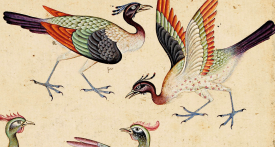
This article is part of an ongoing series on Attar’s Canticle of the Birds (also known as The Conference of the Birds), a spiritual text rich in lessons for spiritual practice. For more information about the book and its author, please refer to the first article in this series entitled “The nightingale and the rose: from attachment to renouncement”.
The focus of this article is on our most intimate enemy: the imperious self. Here is how it is portrayed by Attar…
Read more
Next »
|

 News
News Podcast











Recent Comments